Yoga is often associated with physical postures, flexibility, and strength. But long before yoga became a movement practice, it was a philosophy.
The Yamas are the first limb of the eightfold path of yoga. They are five ethical principles that guide how we relate to others and ourselves.
If you have ever wondered what the Yamas are, or how yoga philosophy applies to modern life, these ancient teachings are surprisingly practical.
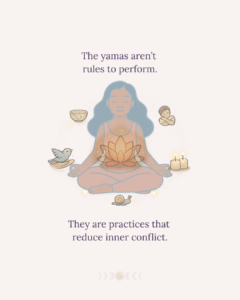
They are not rules. They are relational practices that reduce inner conflict and build integrity.

The Yamas Are Not About Perfection
They are not moral checklists.
They are practices of awareness.
They are invitations to reduce friction between what we believe and how we act.
They cultivate integrity, not performance.
When practiced consistently, they soften anxiety, reduce guilt, and create internal steadiness.

1. Ahimsa – Non-Violence
Non-violence in thought, word, and action.
Most people interpret this as “be kind to others.”
But the deeper work is internal.
How violent are your thoughts toward yourself?
How harsh is your inner critic?
How often do you override your body’s signals?
Ahimsa asks us to begin with gentleness.
Not weakness. Not avoidance.
Gentleness.
When we practice non-violence toward ourselves, we reduce internal war.

2. Satya – Truthfulness
Truth guided by compassion.
Satya is not blunt honesty. It is honest expression filtered through care.
It asks:
• Is this true?
• Is it necessary?
• Is it kind?
In leadership, relationships, and self-reflection, Satya reduces confusion.
Truth prevents resentment from building beneath the surface.
Compassion prevents truth from becoming cruelty.
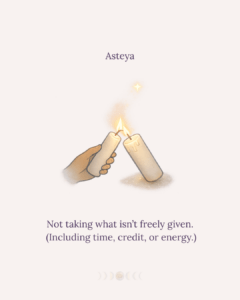
3. Asteya – Non-Stealing
Not taking what is not freely given.
This includes time. Credit. Energy.
Asteya is especially relevant in modern professional culture.
It asks:
• Are you over-consuming others’ emotional labor?
• Are you taking on work that is not yours to carry?
• Are you stealing from your own rest by constantly overcommitting?
Asteya restores balance.
It protects mutual respect.
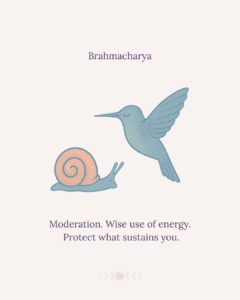
4. Brahmacharya – Wise Use of Energy
Often mistranslated as celibacy, Brahmacharya is actually about moderation and conservation of energy.
Where is your energy leaking?
Where are you spending effort that does not sustain you?
This principle invites discernment.
Not everything deserves your full force.
Protect what fuels you.
Release what drains you.
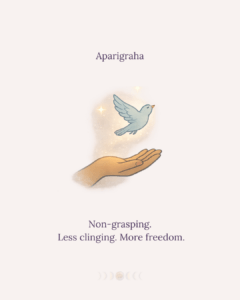
5. Aparigraha – Non-Grasping
Less clinging. More freedom.
Aparigraha asks us to loosen our grip on outcomes, roles, identities, and expectations.
It does not mean apathy.
It means flexibility.
When we cling tightly, we create tension.
When we loosen slightly, we create room.
Room for growth.
Room for change.
Room for reality.
The Five Yamas of Yoga at a Glance
The five Yamas are:
• Ahimsa – Non-violence
• Satya – Truthfulness
• Asteya – Non-stealing
• Brahmacharya – Wise use of energy
• Aparigraha – Non-grasping
Together, the Yamas form the ethical foundation of yoga philosophy. They are not about moral perfection. They are about conscious relationship to self and others.
Why the Yamas Still Matter
The Yamas reduce inner conflict.
They create alignment between belief and behavior.
Between values and action.
They offer a framework for emotional regulation, ethical leadership, and nervous system stability.
You do not need to call yourself a yogi.
You do not need a mat.
You only need willingness to observe your patterns and soften where possible.
The Yamas are not rules to perform.
They are practices that bring you home to yourself.