A Few Reflections From a Conversation With a Friend
Diamond-Michael Scott Aug 29, 2026 The Daily Chocolate Taoist ™
During a text conversation, a friend of mine—someone I consider deeply empathic—said something that stopped me cold:
“It feels like something really big is coming.”
She wasn’t being dramatic. She was describing the approaching fourth quarter of this year that she could already feel in her body, long before it arrived on the calendar.
I told her I could feel it too.
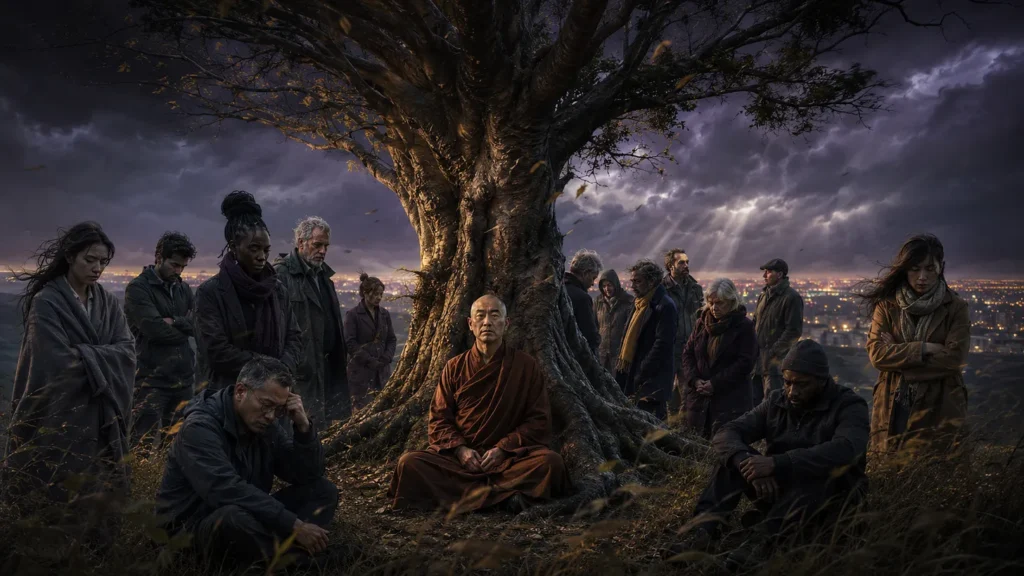
For months, I’ve been having different versions of that conversation with people I know, love, and trust, and sometimes with complete strangers. What stays with me isn’t only what they say. It’s what I see behind their eyes: a particular blankness, accompanied by an exhaustion that has nothing to do with sleep.
These conversations begin as small talk and end with someone telling me about a parent who died, a beloved pet they lost, a frightening diagnosis, an unexpected layoff, or a marriage quietly coming apart at the seams.
People aren’t simply in a mood. They’re in survival mode, and many of them don’t yet have the language to describe the difference.
I have been saying for some time, and will continue to say, that we are living through a profound reordering of the world. This is bigger than a chaotic fourth quarter, a difficult year, or another relentless news cycle. It is a structural transformation—the kind that will eventually be given a name in history books.
Alongside it, something more difficult to measure is unfolding: a shift in human consciousness.
Some people will move through that shift with their awareness intact. Others will be overwhelmed by it. The difference may not come down to luck, wealth, or status.
It may come down to whether they were paying attention.
The Weight Has a Name
I want to be careful here, because it would be easy to write all of this off as vibes, as one more overheated feeling about an overheated year. So let’s start with what’s actually measurable. The World Uncertainty Index, which tracks how often professional analysts use the word “uncertainty” in structured economic reports across 143 countries, hit its highest level in three decades this February, higher than 9/11, higher than the 2008 financial crisis, higher than the worst months of the pandemic.
As reported by the New York Post, tech layoffs tied directly to AI restructuring passed fifty thousand in the first three months of this year alone, a forty percent jump from the year before. Gallup’s global research keeps describing the same thing in softer language: the planet is on an emotional edge.
I bring this up because Chinese philosophy has given me a better vocabulary for it than the news ever did. The tradition speaks of three treasures: jing, the essence we’re born with and spend down over a lifetime; qi, the life force circulating through us; and shen, the spirit that lives in the heart and governs a clear mind and steady emotion.
Prolonged stress stagnates the qi, drains the jing, and agitates the shen (Wikipedia). That is the clinical translation of the blank stare. It is not a weakness. It is a nervous system running on a debt it was never designed to carry for this long, from people who are, quite literally, out of reserve.
Revolution Has a Season
Here is where I think the old teachers actually get ahead of us, because they were describing exactly this kind of moment three thousand years before quarterly earnings calls existed. The I Ching has a hexagram called Gé, Revolution, sometimes translated as Molting. It shows fire trapped beneath a lake, two forces that cannot coexist unchanged, forcing a transformation neither one chose.
The commentary is blunt about what that transformation actually requires: “Revolution succeeds only when its time has come; you cannot force it, but when it arrives, change boldly.” The classical phrase for this is “your own day comes,” meaning belief and support only arrive once the moment has genuinely ripened, not before.
I think this is the piece my empathic friend is actually sensing when she says something big is coming in the fourth quarter. Not a prediction pulled from thin air. A kind of felt timing, the way animals sense a storm hours before the sky changes.
The hexagram right beside Revolution in the old sequence is Xùn, the Gentle, the Penetrating Wind, which describes the same reordering arriving the opposite way, not as a single crack of thunder but as wind that “permeates the smallest cracks,” slow and unceasing until a mountain has been reshaped and nobody can say exactly when it happened.
Some of what’s shifting under us right now is arriving like fire in the lake. Some of it has been arriving like wind for years, and we’re only now noticing the shape of the mountain has changed.
Returning to the Root
The most sobering sentence she shared in our text conversation was this: all the reference points I’ve used my whole life to orient myself no longer apply. She didn’t say that for effect but meant it plainly. The maps she trusted involving career, institutions, the general shape of what a stable decade was supposed to feel like, have stopped matching the terrain.
Lao Tzu has an answer for this, and it is not a new map. In chapter sixteen of the Tao Te Ching, he writes: “Having emptied yourself of everything, remain where you are. All things spring forth into activity with one accord, and whither do we see them return? After blossoming for a while, everything dies down to its root. This going back to one’s origin is called peace… He who knows this preservation is called enlightened. He who knows it does not continue in misery.”
Zhuangzi takes this even further. He famously dreamed he was a butterfly, woke up, and genuinely could not say afterward “whether it was Zhuang Zhou dreaming he was a butterfly, or a butterfly dreaming he was Zhuang Zhou.” Elsewhere he writes that “the Way makes them all into one,” and that “their dividedness is their completeness.” When the categories that used to organize your life, job, identity, nation, are dissolving into something else, Zhuangzi’s counsel isn’t to mourn the boundary. It’s to recognize that boundaries dissolving into new forms is simply what the Way does. It was never going to hold still for us.
We Suffer Together, or We Suffer Alone
My friend who said pulling herself up by her bootstraps feels harder than it’s ever felt, for the first time in her life, wasn’t asking for a pep talk. She was naming something true, something I could truly relate to.
Pema Chödrön has a line I keep coming back to: “Fear is a natural reaction to moving closer to the truth” (Wikiquote). Read that again next to my friend’s bootstraps. Maybe the reason it’s harder now isn’t that she’s gotten weaker. Maybe it’s that she’s standing closer to something real than she’s ever stood before, without the usual scaffolding to soften the view.
Chödrön calls this groundlessness, and she doesn’t dress it up:
“Anyone who stands on the edge of the unknown, fully in the present without reference point, experiences groundlessness”
That is precisely the sentence I said to myself about my own vanished reference points. It turns out it has a name, and Buddhist teachers like Chödrön have been mapping it for centuries.
I was talking with Miguel Clark Mallet on Substack Notes the other day about how the words of Thich Nhat Hanh give the loneliness inside all of this a different shape. His core teaching is interbeing, the idea that nothing exists independently of anything else. “Interbeing is the understanding that nothing exists separately from anything else. We are all interconnected… Happiness and safety are not individual matters. If you suffer, I suffer.”
Every one of those conversations I’ve been having, the dead parent, the dead pet, the layoff, the marriage coming apart, isn’t a separate private tragedy landing on unlucky individuals. It’s one field of grief and depletion surfacing through many mouths at once. We are not each carrying our own weather. We are standing in the same weather, and pretending otherwise is what makes it unbearable.
The Quality Called Omniscience
I offered a thought to another friend recently that I want to unpack properly here. I said it’s only when we’ve risen to the highest level of consciousness that we become capable of seeing every aspect of the whole simultaneously. This quality is known as omniscience.
That word has an actual home in Buddhist philosophy, and it’s worth visiting properly instead of throwing it around. The classical term is sarvajñatā, and the tradition holds that “an omniscient person perceives all objects of the world simultaneously in a single cognitive moment”.
But here’s the part that changes how I hold the word. When rival ascetics in the Buddha’s own time boasted that they possessed this quality constantly, effortlessly, in every waking moment, the Buddha was recorded as more careful than that, correcting the claim rather than accepting it as a badge to wear.
Seeing the whole simultaneously was never presented as a mood you fall into on a hard week. It was the fruit of an entire discipline, earned slowly, and even the Buddha didn’t claim it lightly.
I think that distinction matters enormously right now, in a culture full of people online claiming they’ve “awakened” between breakfast and lunch.
The shift in consciousness I keep talking about isn’t a badge. It’s closer to what the old teachers meant by paying attention, over years, until the whole thing stops looking like fragments and starts looking like one moving thing. Most of us, myself absolutely included, are still watching pieces. That’s not a failure. It’s just honest about where we actually are on the path.
Harmony Is a Practice, Not a Mood
Which brings me to the question that actually keeps me up at night. How do we get people to prioritize harmony within themselves, with each other, and with the natural world, when we were never given the emotional education to do it?
I don’t think harmony is a feeling you wait to arrive. I think that’s the trap. The Bhagavad Gita gives the clearest instruction I’ve found anywhere, in a single verse, chapter two, verse forty-eight: “Be steadfast in the performance of your duty, O Arjun, abandoning attachment to success and failure. Such equanimity is called Yog.”
In this excerpt, Krishna isn’t telling Arjuna to feel calm before he acts. He’s telling him to act, fully, and release his grip on how it turns out. That releasing is the harmony. Not a prerequisite for it.
This is, I think, the actual answer to the bootstraps problem. We’ve been taught that harmony comes after the outcome resolves, once the layoffs stop, once the diagnosis clears, once the world order finishes reordering itself into something legible again. The Gita says the opposite. Harmony is available now, precisely because it never depended on the outcome in the first place. It was always a discipline of the doing, not a reward for the ending.
What the End of an Age Actually Means
There’s one more piece of Eastern cosmology I want to leave you with, because it’s the only framework I’ve found that’s honest about scale. Hindu tradition describes four ages, or yugas, cycling in order, each one a little more depleted than the last. We are, by that tradition’s own reckoning, deep into Kali Yuga, the age of exhaustion and forgetting. And the tradition says something specific about how that age ends: “near the end of Kali Yuga, when virtues are at their worst, a cataclysm and a reestablishment of dharma occur to usher in the next cycle’s Satya Yuga.”
I want to be honest with you about what that framework can and can’t promise. It operates on a timescale of hundreds of thousands of years, not a fiscal quarter, and I’m not going to pretend it forecasts October. But the structural claim underneath it is one I believe with my whole chest: intensifying exhaustion has, in every tradition that’s bothered to track it, historically preceded not annihilation but reordering. Not the end of the story. The turning of a page in it.
So when my friend tells me something big is coming, I don’t try to talk her out of the feeling, and I don’t try to confirm a date for it either. I tell her the truth, which is that the old teachers all seem to agree on one thing across every tradition I’ve mentioned here: the people who come through a reordering intact aren’t the ones who see it coming first. They’re the ones who were already practicing stillness, already returning to the root, already loosening their grip on the outcome, long before the wind ever picked up.
That’s the whole of what being awake in the midst of this actually means. Not knowing what’s coming. Just being the kind of person the coming doesn’t undo.
Source: https://chocolatetaoist.substack.com/p/something-is-about-to-go-down-in